
Competency framework design in the UK: choosing an approach
Competency framework design in the UK should translate an organisation’s goals into clear capabilities and observable behaviours for relevant roles. A framework that lists behaviours without connecting them to real work can create confusion instead of clarity.
Competence and competency are often used in related ways, but a framework’s purpose matters more than its label. A useful framework gives employers and employees a shared language for expectations, development and progression, with criteria grounded in the work people actually do.
This article explains the terminology and how intended outcomes, timescale and budget shape the design approach. It also covers implementation planning and how employers and subject-matter experts can contribute the insight needed to make a framework credible and usable.
Table of Contents
What are competence and competency frameworks?
A competence or competency framework describes the knowledge, skills and behaviours needed for work. The terms overlap, although some organisations use “competence” for demonstrated ability and “competency” for the attributes that support it. Either way, the framework turns expectations into practical criteria for individuals and teams. For example, a customer-facing role might require clear communication, accurate record-keeping and sound judgement.
Employers can use these criteria for recruitment, development and promotion. For recruitment, role-specific behaviours can shape interview questions and assessment tasks. For development, managers can compare observed performance with the framework to identify learning needs. For promotion, consistent criteria clarify the responsibilities and behaviours expected at the next level. Describe behavioural competencies as observable actions at each proficiency level: an entry-level employee might share relevant information, while a more experienced colleague adapts communication for different audiences.
UK employers should keep criteria relevant to each role, assess people consistently and consider whether wording or assessment methods create unfair barriers. Evidence-based behaviours, accessible assessments and regular reviews help reduce equality risks. Avoid vague criteria such as “culture fit”.
Frameworks can also inform qualifications and assessment strategies. A Skills Development Scotland programme for carpentry and joinery pre-apprenticeships produced qualification design specifications, qualification products and an assessment strategy. Consultation can strengthen the work: a working group can test draft criteria with employees and subject-matter experts, then revise unclear or incomplete details. Skills for Justice and Skills for Health helped develop the Non-Custodial Career and Competence Framework for identified roles in healthcare settings, including criminal courts and mental health facilities.
Frameworks can support sector-specific standards, but they need to reflect the work and risks involved. The Independent Review of Building Regulations and Fire Safety was published in May 2018 and followed the Grenfell fire, according to UK Government. The Building Safety Act 2022 introduced a new regulatory regime for the built environment in the UK, according to UK Parliament. Continuing professional development helps individuals maintain and justify professional competence as roles and knowledge evolve.
Choosing a design approach with a competency framework design partner
Choose an approach by weighing the organisation’s intended outcomes, timescale, budget and workforce needs. Competency framework design in the UK should provide enough detail to guide decisions while allowing for differences between roles and working contexts.
Strengths and Weaknesses of Competency Approaches
A competency-based approach describes work through observable capabilities, helping managers apply consistent criteria to people decisions. It can support recruitment, performance discussions and professional development by making expectations easier to explain. But an overly detailed model can encourage box-ticking, miss changing responsibilities or narrow how contributions are recognised. Balance shared standards with role-specific examples, then test whether managers can apply the criteria to real decisions.
Evidence and User Research
Evidence-based design combines existing information with stakeholder insight to identify capabilities that matter in practice. Review role descriptions, workforce plans and current assessment methods, then ask employees and managers about day-to-day work. Researchers or analysts can test design ideas against evidence, while workshops can expose unclear wording and missing perspectives. Across UK roles and levels, compare responsibilities, test draft behaviours with subject-matter experts and revise criteria that lack practical examples.
A typical design process moves from defining intended uses to research, drafting, consultation and validation. This sequence keeps the framework aligned with the decisions it needs to support, rather than starting with a generic template.
Development Costs and Timelines
There is no single typical UK cost or timeline: both depend on project scope and delivery choices. Competency framework design in the UK might cover a focused group of related roles or a wider workforce, with different research and consultation needs. Factors include the number of roles, existing evidence, stakeholder access, assessment design and testing. Use these constraints to build a proportionate plan, clarifying priorities and the time needed for consultation and review.
Competence framework implementation plans
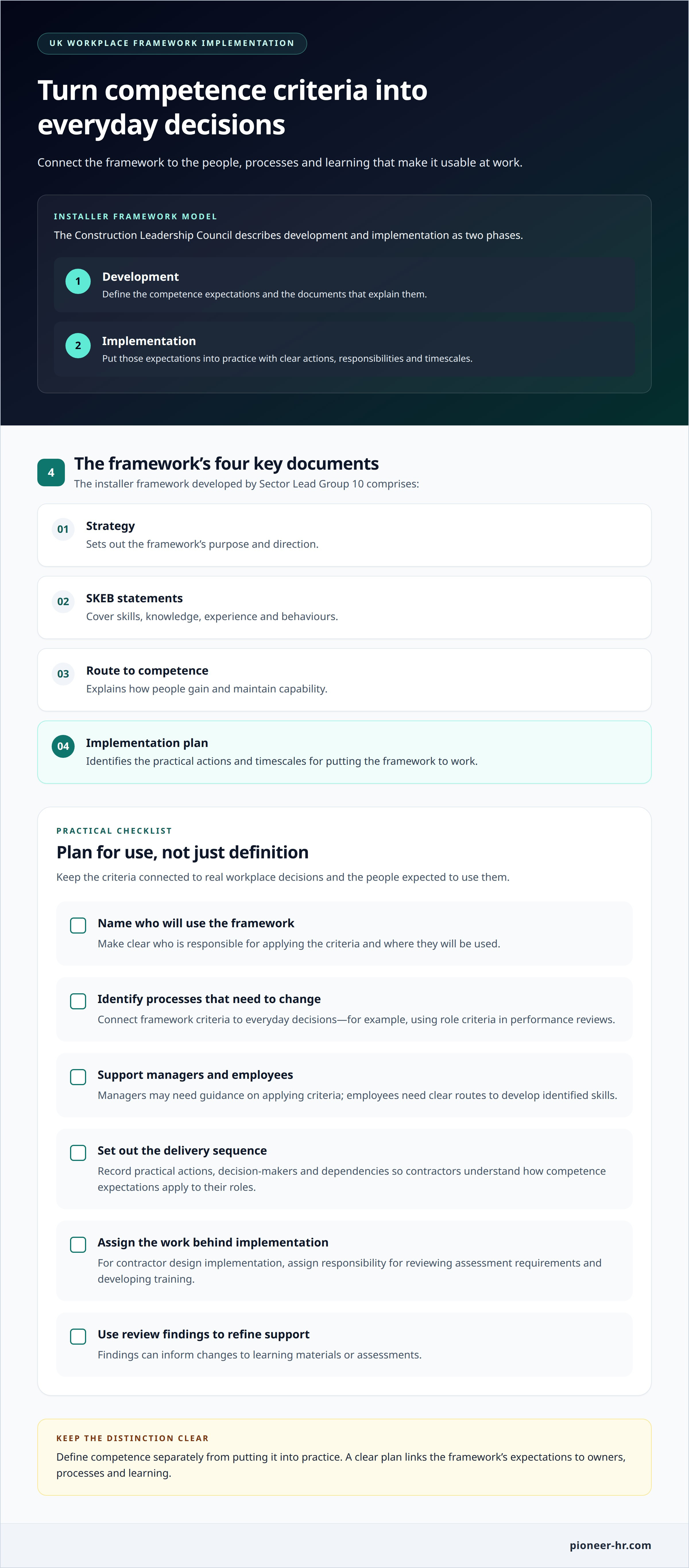
A framework becomes useful when leaders connect its criteria to everyday decisions. An implementation plan should specify who will use it, which processes will change and how learning will be supported. Managers, for example, may need guidance on applying role criteria in performance reviews, while employees need clear routes to develop identified skills.
For installers, the Construction Leadership Council describes development and implementation as two phases. The installer framework developed by Sector Lead Group 10 comprises four key documents:
A strategy setting out the framework’s purpose and direction.
SKEB statements covering skills, knowledge, experience and behaviours.
A route to competence explaining how people gain and maintain capability.
An implementation plan identifying practical actions and timescales.
Separate defining competence from putting it into practice. In contractor design implementation, the plan can assign responsibility for reviewing assessment requirements and developing training. Set out the sequence of work, decision-makers and dependencies so contractors understand how competence expectations apply to their roles. Findings from reviews can then inform learning materials or assessment changes.
Effective implementation also needs a working group to coordinate communication and resolve practical issues. Leaders can agree how the framework will inform recruitment, development and performance processes, while managers apply its criteria consistently. A measured rollout gives teams time to understand new expectations before they shape important people decisions. Employee and supervisor feedback can reveal where examples or guidance need clarification.
Future-proofing means anticipating skills needs, auditing current capability and planning to develop or hire essential skills. Establish how the framework will be reviewed and updated as work changes. Knowledge transfer matters too: contributors need enough understanding to maintain the framework without ongoing consultant dependence. These steps turn the framework into a working resource rather than a document that sits unused.
Employer and subject-matter expert involvement
Employers and subject-matter experts bring different evidence to framework development. Employers clarify organisational priorities, role boundaries and how skills are used in practice. Technical specialists can check whether proposed competencies reflect current methods, risks and professional expectations. Draw on both perspectives, then check that draft statements describe demonstrable work rather than abstract qualities.
Timber engineering illustrates why sector expertise matters. Edinburgh Napier University and the New Model Institute for Technology & Engineering commissioned a framework documenting the knowledge, meta-skills and industry experience needed by future timber engineers. Research examined job descriptions, professional body requirements and existing competency guides, alongside interviews with sector stakeholders. Timber Development UK published the project output as a Skills Action Plan, and the work was cited in the 2023 Timber in Construction Policy Roadmap.
Consultation gives employers and practitioners a practical way to challenge draft criteria. A nursing competence-framework study sent 54 framework items to 600 nursing practitioners, showing how feedback can test whether proposed statements make sense across a profession. In another UK example, a competence framework for trainee general practitioners used a three-stage method that included stakeholder interviews and validation. These approaches help identify unclear wording, gaps and differences between expected standards and day-to-day conduct.
Qualifications, experience and training provide evidence of professional competence, but each has a different role. A qualification can demonstrate structured learning; experience shows how someone applies skills in context; training can address specific capability needs. Employers and subject-matter experts should help define what evidence is relevant for each role, while avoiding assumptions that one credential alone captures every aspect of performance. For employee perspectives, explore employee engagement surveys as a way to gather views that can inform organisational decisions.
Pioneer HR
Pioneer HR helps employers connect people priorities with organisational goals when a framework needs to support wider workforce decisions. Its Reward Strategy can help align expectations around roles and contribution, while Fractional Chief People Officer support provides strategic people leadership as priorities take shape. This can help a framework fit alongside existing reward structures, management practices and future workforce plans.
The right starting point depends on what the organisation needs the framework to achieve and how it will be used. Reward Strategy is one relevant part of that wider picture, rather than a substitute for clear role criteria and implementation planning.
If you’d like to discuss your organisation’s people priorities, contact Pioneer HR.
Give your framework a clear next step
A framework can shape how people decisions are made, so its value depends on how well it fits your organisation’s priorities. Treat it as a working part of your people strategy, with clear ownership and a practical route from agreed expectations to everyday practice. Competency framework design in the UK is therefore about organisational fit, not simply choosing a template.
Pioneer HR offers Retained HR Services, Salary Benchmarking and Reward Strategy to support wider thinking about roles, people priorities and reward. The right focus depends on the decisions your framework needs to inform and the challenges your organisation is addressing.
Contact Pioneer HR to discuss your framework and consider how it can support your organisation’s next stage. A thoughtful, well-aligned approach gives you a strong foundation for meaningful progress.
Frequently Asked Questions
What is a competency framework and what is it used for in UK organisations?
A competency framework sets out the capabilities an organisation expects people to apply in their roles. Beyond day-to-day management, it can support workforce planning by showing where current capability differs from future requirements. For example, a business preparing to introduce a new service can identify the capabilities needed, assess its existing workforce and plan how to develop or recruit those skills.
What is the difference between a competency framework and a skills framework in the UK?
A skills framework usually focuses on specific abilities people can apply, such as analysing data or operating equipment. A competency framework may include skills while also describing knowledge, behaviours and how someone applies them in context. The labels are not consistent across every UK sector, so focus on the content: does the framework assess isolated skills or broader role performance?
How can a design partner involve employees, managers and unions in designing a competency framework?
A design partner can involve employees, managers and union representatives through interviews, facilitated workshops and reviews of draft criteria. Each group offers a different perspective: employees know the tasks involved, managers explain role expectations, and union representatives can raise workforce concerns. Record the feedback, resolve conflicting views with project sponsors and revise language participants find unclear or impractical.
How can a competency framework be used for recruitment, performance management, learning and career development?
For recruitment, role criteria can shape interview questions and work-based assessment tasks. In performance conversations, managers can discuss specific examples against agreed expectations rather than relying only on broad impressions. Learning plans can target capabilities that need development, while career discussions can connect progress with future-role expectations. Consistent use makes the framework a practical reference, not just a recruitment document.
What are examples of effective competency frameworks used by UK employers or public sector organisations?
The UK Department for Education’s design framework offers an example of progression across public-sector design roles. It expects HEO designers to explain problems and design ideas clearly, while G7 designers document decisions, risks and unresolved issues. At G6, lead designers embed iterative design and coach others. These examples show how role-specific behaviours can become more complex as responsibility grows.



Comments