
How to develop future leaders through succession planning for small business
A leadership handover is more resilient when it’s planned before a key person leaves. Succession planning for a small business means identifying how ownership and management could transfer, deciding which roles are essential, and preparing people to take them on. It also gives you a way to pass on knowledge, so important relationships and day-to-day decisions don’t depend on one person alone.
It’s understandable to focus first on who might lead next. But succession planning for a small business is about more than naming a successor: it should reflect what the business needs, what potential leaders want and how they can build the skills and experience the role demands. For a family-run firm in Kent or a growing business in London, clear criteria and open conversations help make those choices.
This guide explains how to map priority roles, identify possible successors and develop them through training, mentoring and practical experience. It also covers documenting a handover, preparing for unexpected vacancies and reviewing the approach as your business changes, so you can build leadership continuity at a measured pace.
Table of Contents
What is business succession planning?
Business succession planning sets out how ownership and leadership will transition when an owner steps back. For a family firm, it helps separate the business’s future from assumptions about which generation or family members should lead.
Compare Family Succession With Other OptionsDecide whether a family handover fits the business’s future and the intended successor’s interests. Compare it with a sale to another company or a buyout by employees, considering who can lead and preserve essential customer relationships. Record the preferred route and how ownership, decisions and disagreements will be handled. Don’t treat family connection alone as evidence of suitability.
Prepare Family Successors Through Business ExperienceGive potential successors experience across different parts of the business before assigning leadership responsibility. For example, a family member might gain insight into customer relationships, operations and financial decision-making, rather than learning only one function. Set out the skills each priority role requires, then use practical responsibilities and performance reviews to assess readiness. Discuss career goals directly instead of assuming someone wants the role.
Separate Family Relationships From Business DecisionsUse written job descriptions and consistent performance criteria to assess family members fairly. Record the responsibilities, experience and behaviours expected in each leadership role, then apply the same standards to every candidate. This makes decisions easier to explain when relatives have different expectations. Keep discussions about family relationships distinct from evidence of business performance, and establish a clear process for resolving disagreements.
Assess Value and Transfer ConsiderationsMap the transfer route and its financial, legal and practical requirements before agreeing a handover. For a UK transfer or sale, capital gains tax and inheritance tax may be relevant; the implications depend on the ownership structure and transaction. Documents vary, but planning may coordinate company records, ownership-transfer agreements, shareholder arrangements and wills. Accounting and solicitor costs depend on the scope of work, transaction complexity and records involved. Value the business by assessing maintainable earnings, assets, liabilities and relevant market evidence, using a method suited to its circumstances.
Identifying and developing future leaders
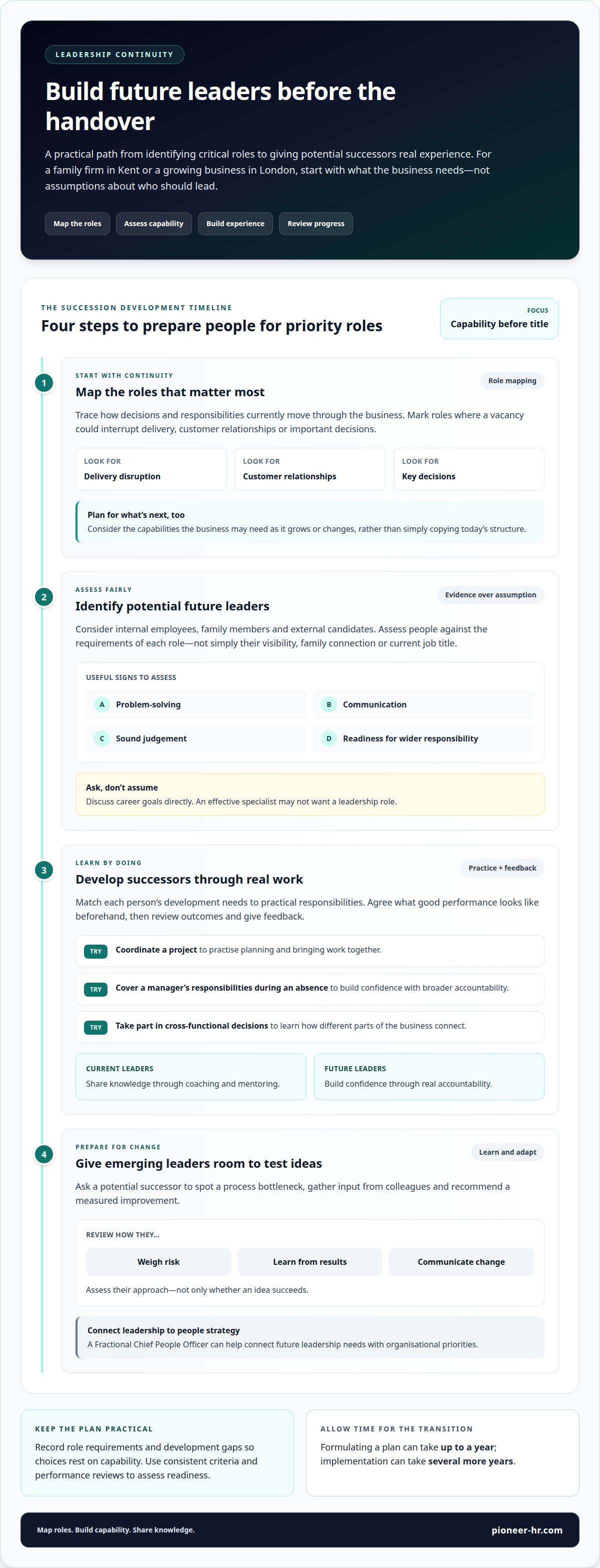
Start with the roles that most affect continuity, then identify people who could grow into them. A useful development plan links each role’s responsibilities to the knowledge and abilities a successor needs.
Map Organisational Structure and Future RolesMap how decisions and responsibilities currently flow through the business. Mark roles where a vacancy could disrupt delivery, customer relationships or key decisions. Then consider which capabilities the business will need as it grows or changes, rather than simply reproducing today’s structure. For example, a team leader may need broader commercial judgement before taking responsibility for an entire function.
Identify Future LeadersConsider internal employees, family members and external candidates as potential successors. Assess evidence such as problem-solving, communication, sound judgement and willingness to take on wider responsibilities. Discuss each person’s career goals directly; don’t assume an effective specialist wants a leadership role. Record role requirements and development gaps so selection rests on capability rather than visibility or personal preference.
Develop Future SuccessorsMatch each candidate’s development needs with practical assignments. Someone preparing to lead operations could coordinate a project, cover a manager’s responsibilities during an absence or take part in cross-functional decisions. Agree what good performance looks like beforehand, then review outcomes and provide feedback. A gradual handover also lets current leaders share knowledge through coaching and mentoring, while successors build confidence through real accountability.
Consider Innovation in Future LeadershipGive emerging leaders opportunities to test ideas and respond to changing business conditions. For instance, ask a successor to identify a process bottleneck, gather input from colleagues and recommend a measured improvement. Review how they weigh risk, learn from results and communicate changes, not only whether an idea succeeds. For businesses shaping a broader people strategy, a Fractional Chief People Officer can help connect future leadership needs with organisational priorities.
Business succession planning best practices
A practical business succession plan links future leadership with continuity, clear responsibilities and regular review.
Write down the transition stages, decision-making arrangements and contingency steps for priority positions. Include who takes responsibility if a key person leaves unexpectedly, how colleagues receive handover knowledge and how customer relationships are maintained. A documented process gives owners a shared reference instead of relying on informal assumptions. Formulating a plan can take up to a year, while implementation can take several more years.
Define the experience, knowledge, skills and behaviours needed in each priority role. Use these criteria to set development goals and assess readiness consistently. For example, someone preparing to lead a customer-facing team might need experience resolving service issues and managing team priorities. Cross-training employees across roles can also help cover an unexpected departure and reduce dependence on one person.
Agree how potential successors will learn about their future responsibilities. Set out a phased handover, practical assignments and checkpoints to review progress. A candidate might first lead a defined project, then take on broader decisions with support from the current role-holder. Keep communication transparent: discuss the person’s interests and explain expectations rather than assuming they want the position.
Review the plan regularly and update it when roles, people or business priorities change. Trial periods and performance checkpoints can show whether a proposed handover works in practice; revise responsibilities if the evidence points to a gap. Keep strong business records to help owners spot operational issues and address risks earlier. For ownership transfers, include appropriate legal and tax advice in the planning process, alongside leadership and continuity decisions.
When should a UK small business start succession planning?
Start before a handover becomes urgent, leaving time to prepare people and operations.
Work backwards from your intended transition date. A small business owner should devise a succession strategy at least three years before intended retirement. Experts commonly recommend beginning preparations three to five years before the desired transition. That lead time gives owners room to identify future leaders, transfer knowledge and phase responsibilities. If you’re considering retirement, use your intended date as a practical starting point.
Begin sooner if a key role depends heavily on one person. An unexpected departure can leave decisions, customer relationships or specialist knowledge without clear cover. Identify positions where an absence would interrupt essential work, then map who could step in temporarily. This is useful even when retirement feels distant, because it separates continuity planning from the timing of an eventual ownership transfer.
Use business changes as a reason to review timing. A new service, a growing team or an owner taking on fewer operational duties can reveal leadership gaps. Record the knowledge and decisions the business currently relies on, then assign development opportunities to build capability. A staged approach lets a future leader take on responsibilities progressively instead of facing a sudden handover without preparation.
Set a review point and keep the plan current. The 47% figure for family business owners who have started succession planning shows that planning is not universal; it is not a reason to delay. Revisit your intended transition date, successor interests and role requirements as circumstances change. If a proposed successor’s goals or readiness shift, update the timeline and development steps instead of treating the original plan as fixed.
Pioneer HR
Pioneer HR can help you connect succession planning with the people and leadership needs of your business. Turn to the team when you need to clarify future roles, support managers through change or build a more structured approach to developing talent. Depending on your priorities, support may include leadership and organisational development, reward strategy, salary benchmarking or ongoing Retained HR Support.
For example, a business preparing an internal successor may need clearer role expectations and a plan to develop their leadership capability. A growing team may instead need HR support that adapts as its structure changes. The right focus depends on your transition plans and workforce needs.
Contact Pioneer HR to discuss the people-related priorities in your succession plan.
Make leadership continuity part of your next business decision
Your next step doesn’t need to be a complete handover plan. Choose one leadership priority to clarify, such as which decisions should no longer depend on a single person. This connects succession planning for a small business with everyday management, rather than treating it as a document to revisit only when change is imminent.
As the business develops, revisit whether its future leadership needs still match its direction. New services, changing responsibilities or different employee expectations can shift the capabilities required. Keep the discussion practical: identify the decisions ahead, the people who need to contribute and the support that would help them prepare.
Pioneer HR offers Retained HR Support, Salary Benchmarking and Reward Strategy to support employers with people-related priorities that shape their workforce. If you’d like to explore how those needs connect with your succession plans, contact Pioneer HR to discuss your next steps.
A considered first move can help shape a leadership transition around your people and your business’s future.
Frequently Asked Questions
Why is succession planning important?
Succession planning helps protect the business when an owner or key decision-maker leaves. Without an agreed successor, routine choices can stall, customers may not know who to contact and employees may feel uncertain about their future. For example, a small firm can document who approves supplier orders during a leadership transition. That clarity supports continuity while longer-term ownership and leadership decisions take effect.
What is succession planning for a small business?
Succession planning for a small business is a structured approach to preparing for changes in ownership or leadership. It can identify the decisions that need to transfer, the people who may assume responsibility and the information they’ll need. For example, a founder might gradually hand over supplier negotiations and team oversight while remaining available to share context during the change.
What are the main succession options for a small business: family transfer, management buyout, or sale?
The main options are transferring the business to a family member, selling it to its existing management team or selling to another buyer. A family transfer may suit an interested relative who understands the business; a management buyout may suit leaders already familiar with its operations. A sale can be relevant when there’s no suitable internal successor. Compare each route’s effect on control, continuity and the owner’s aims.
What steps are involved in creating a small business succession plan in the UK?
Begin by identifying the ownership and leadership decisions the plan must address. Next, define the responsibilities that need cover, identify potential successors and set out how knowledge and authority will pass to them. Record the intended transition route, timing, decision-making arrangements and contingency steps. For a UK ownership transfer, include appropriate accounting and legal advice so the plan reflects the transaction’s financial and documentation requirements.
How can a small business reduce disruption and retain employees during a succession?
Reduce uncertainty by explaining what will change, what will stay stable and who employees should approach with questions. For example, a manager taking over a department can meet the team before responsibilities transfer and clarify how decisions will be handled. Keep key employees involved in planning, give them opportunities to learn new duties and maintain regular conversations about concerns. Clear communication can support trust and help preserve valuable business knowledge.
What are the risks of not having a succession plan for a small business?
Without a plan, a sudden departure can leave critical decisions, customer relationships and specialist knowledge without an obvious owner. Employees may receive conflicting direction or feel uncertain about their roles, while customers can experience slower responses. The business may also have fewer options if an owner needs to step back quickly. Identifying interim decision-makers and recording essential processes can reduce these vulnerabilities before a vacancy occurs.



Comments