
How to improve team communication through clear norms
More tools won’t fix communication if everyone uses them differently. Knowing how to improve team communication starts with agreeing how information is shared, where decisions are recorded and what colleagues can expect from one another. Team communication includes everyday conversations, emails, video calls and collaboration tools, whether people work in the same office or across locations.
Communication can feel harder in a hybrid team: a quick question in a London office may need a different route to reach a colleague working remotely in Kent. Clear, practical norms help everyone choose the right channel, understand when a response is needed and follow through on meeting actions. This article explains how to set channel and response expectations, capture decisions and actions, and choose tools for remote and office-based teams across the UK.
Table of Contents
1. What is team communication?
In a UK workplace, team communication is the exchange of information people need to coordinate work, make decisions and raise concerns. It happens in conversations, meetings, emails and shared documents. It works best when colleagues understand the message and what they need to do next. For example, a project update should clarify whether someone is sharing progress, asking for input or requesting a decision.
Teams communicate verbally through speaking and discussion, and nonverbally through facial expressions, gestures and tone. Written communication includes email, chat messages and meeting notes; visual communication uses diagrams, charts or project boards to make information easier to understand. A manager explaining a new process might talk through the change, share a written summary and use a flowchart to show each step. Choose a format that suits the information and the people receiving it.
Active listening helps colleagues understand the point behind someone’s words, rather than preparing a reply while they are speaking. In a one-to-one conversation, a manager can focus without interrupting, ask a clarifying question and summarise the key point: “You’re concerned the deadline leaves too little time for review.” The speaker can then confirm or correct that understanding. This makes feedback more useful and can reveal a misunderstanding before it develops into conflict.
Managers can assess communication and collaboration by combining team feedback with practical indicators, such as whether decisions have clear owners and colleagues can explain shared priorities. In a project meeting, they might ask where a handoff stalled and review whether the agreed action was completed. Patterns in conversations and work processes can show what needs attention.
Communication also depends on whether people feel able to contribute. A meeting where only the manager speaks offers little opportunity to hear concerns or ideas. Inviting each colleague to comment on a proposal gives a clearer picture of the team’s understanding. For teams working across London, Kent or elsewhere in the UK, consistent listening and clear follow-up help connect different perspectives to shared objectives.
2. Setting communication channels and response-time norms
The most effective ways to improve communication in a team are to agree where messages belong, set realistic response expectations and connect updates to shared goals. Leaders should also make it clear that questions, feedback and differing views are welcome, so colleagues know how to contribute.
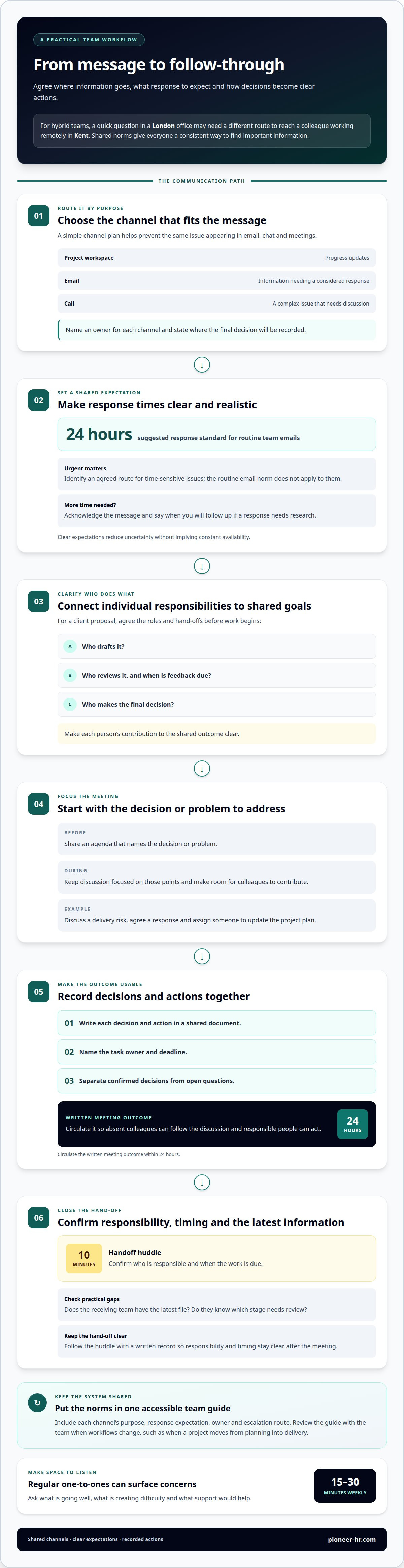
A simple channel plan prevents the same issue appearing in email, chat and meetings. For example, use the project workspace for progress updates, email for information that needs a considered response, and a call for a complex issue that needs discussion. Name an owner for each channel and state where the final decision will be recorded. This gives office-based and remote colleagues the same route to important information.
Set a response norm that reflects the message’s urgency and the team’s working arrangements. One suggested standard is a response to team emails within 24 hours. Make clear that this applies to routine messages, not urgent matters; identify the agreed route for time-sensitive issues. If a response needs research, colleagues can acknowledge the message and say when they’ll follow up. Clear expectations reduce uncertainty without implying constant availability.
Team expectations should cover responsibilities as well as channels. For a client proposal, the team might agree who drafts it, who reviews it, when feedback is due and who makes the final decision. Individual goals should show each person’s contribution to the shared outcome. This connects day-to-day collaboration with a meaningful team priority and helps colleagues understand how their responsibilities fit together.
Leaders set the tone through their own behaviour. They can encourage an open culture by explaining decisions, inviting questions and responding constructively to concerns. Listening matters: if a colleague flags a risk in a meeting, the manager can acknowledge it, clarify the next step and share the outcome with everyone affected. These visible actions make agreed norms credible.
To put these principles into practice, write the channel, purpose, response expectation, owner and escalation route in one accessible team guide. Review it with the team when workflows change, such as when a project moves from planning into delivery. For those learning how to improve team communication, consistent norms turn individual preferences into a shared way of working.
3. Summarising meeting decisions and action items
Effective meetings start with an agenda that names the decision or problem to address. Share it beforehand, then keep discussion focused on those points. For example, a project meeting might cover a delivery risk, agree a response and assign someone to update the project plan. This structure helps employees contribute while keeping the meeting’s purpose clear.
Record each decision and action in a shared document, including the task owner and deadline. Circulate the written meeting outcome within 24 hours, so absent colleagues can follow the discussion and responsible people can act. Separate confirmed decisions from open questions. If a proposal still needs approval, name who will decide and when the group expects an update.
For a task moving between teams, use a 10-minute handoff huddle to confirm responsibility and timing. A short conversation can resolve practical gaps, such as whether the receiving team has the latest file or knows which stage needs review. Follow it with a written record, so the handoff remains clear after the meeting ends.
One-to-one meetings give managers space to discuss workload, wellbeing and concerns that employees may not raise in a larger group. A weekly manager-employee conversation can be meaningful in 15 to 30 minutes. Ask what is going well, what is creating difficulty and what support would help. This regular sharing can strengthen working relationships and surface issues before they affect collaboration.
Teams can improve communication across departments and time zones by agreeing a shared agenda, recording decisions in an accessible place and assigning actions with clear owners and deadlines. State the relevant time zone when setting a deadline, and send written updates when colleagues cannot attend the same meeting. Cross-departmental meetings can then focus on shared objectives, dependencies and unresolved issues instead of repeating background information.
These practices create a reliable loop: prepare, discuss, document and follow up. If a decision changes, update the record and tell every affected team so colleagues can work from the same information.
4. Communication tools for remote and office teams
Choose tools based on what the message needs to achieve, not by habit. Team communication happens through conversations, email, video calls and collaboration tools. Remote and office-based colleagues should be able to find the same important information, even if they use different devices or work patterns.
Email suits messages that need context or a considered reply, such as a project update. Chat works for brief coordination, such as confirming who will prepare a document. Use a meeting or video call when people need to explore a complex issue together. Giving each message a clear purpose reduces the risk of important details getting lost across channels.
Project-management tools or shared workspaces can keep task owners, progress updates and key files in one place. For example, a team planning a client launch can use a shared board to track milestones and keep discussion about a task beside it. Record final decisions in an agreed location rather than relying on chat history or someone’s memory.
Remote and hybrid teams need tools that support participation as well as information sharing. A colleague joining a meeting from Kent should be able to follow the discussion, view relevant materials and contribute, even when others are together in a London office. Circulate documents before the call, use clear file names and summarise outcomes afterwards. These practices make digital tools more useful without assuming everyone has the same communication skills or preferences.
For effective communication, agree what each tool is for, where important updates belong and how colleagues can access them. Keep the number of channels manageable, then review whether people can locate current information and contribute to decisions. If managers need to strengthen the people skills behind these practices, develop managers’ communication skills through focused training.
Pioneer HR
Pioneer HR helps organisations connect communication practices with their wider people strategy. When unclear expectations, limited employee feedback or inconsistent management approaches affect collaboration, its HR support can help leaders consider the underlying organisational issues. Employee Engagement Surveys can provide a structured way to understand how employees experience communication and workplace culture. For businesses seeking strategic people leadership, a Fractional Chief People Officer can help align people priorities with organisational goals. Retained HR Support offers ongoing practical and strategic guidance as workplace needs evolve. These options may be relevant when teams need more than a new channel or meeting format, and need a considered approach to people, leadership and engagement. Contact Pioneer HR to discuss your organisation’s needs.
Make communication norms part of how your team works
Clear communication is an ongoing practice, not a policy that sits untouched. Choose one point of friction to address first, then invite colleagues to share what would make the agreed approach useful in their day-to-day work. Their feedback can help leaders refine expectations as responsibilities or working arrangements change.
Learning how to improve team communication can also prompt wider questions about how people priorities fit together. Where communication concerns overlap with broader workforce planning, Pioneer HR offers Retained HR Support, Salary Benchmarking and Reward Strategy. These services address different people priorities, so the right next step depends on the issue your organisation wants to resolve.
Start with a practical conversation about what your team needs to work together well. Contact Pioneer HR to discuss your organisation’s people priorities, and take the next step with care and clarity.
Frequently Asked Questions
What is team communication?
Team communication is how colleagues exchange and interpret information while working towards shared outcomes. It includes communication between peers, managers and departments, as well as with people outside the immediate team. For example, a customer-service colleague may pass a recurring customer concern to the product team, connecting frontline experience with decisions about future work.
How Do Remote or Hybrid Teams Improve Teamwork?
Remote and hybrid teams can strengthen teamwork by making participation possible across different locations. Share relevant context before discussions, invite written contributions from people who cannot attend, and make space for informal relationship-building. For example, a colleague working from home should have a clear way to raise a concern without being physically present in the office.
How can lack of communication affect teamwork?
Poor communication can leave colleagues acting on different assumptions, leading to duplicated work or missed dependencies. If a design change isn’t shared with the team preparing customer materials, for instance, both groups may complete work that needs revising. Over time, uncertainty about priorities can also make it harder for employees to raise problems early or coordinate their contributions.
What Are Practical Teamwork Tips for Better Performance?
Define what “finished” means before a shared task begins, so colleagues can assess quality against the same standard. For example, a report might need an agreed format, reviewed figures and approval from a named decision-maker. For complex work, invite a colleague to review an early draft, then hold a brief retrospective to identify one improvement for the next project.
What Is Reflective Communication?
Reflective communication means pausing to consider how a message was expressed, received and understood. After a difficult discussion, a manager might ask, “Did I explain the reason for this change clearly?” They can also consider whether their tone matched their intention. This reflection helps people adjust future conversations and clarify misunderstandings without assuming the other person understood the message as intended.
What Is the Leader’s Role in Team Effectiveness?
A leader helps a team work effectively by setting direction, clarifying decision-making responsibilities and removing barriers to progress. They can also spot when a process repeatedly creates confusion and address the cause, rather than relying on employees to compensate each time. For example, if project handovers often stall, the leader can review responsibilities and revise the workflow with the teams involved.



Comments