
Interview Training for UK Managers to Assess Candidates Fairly
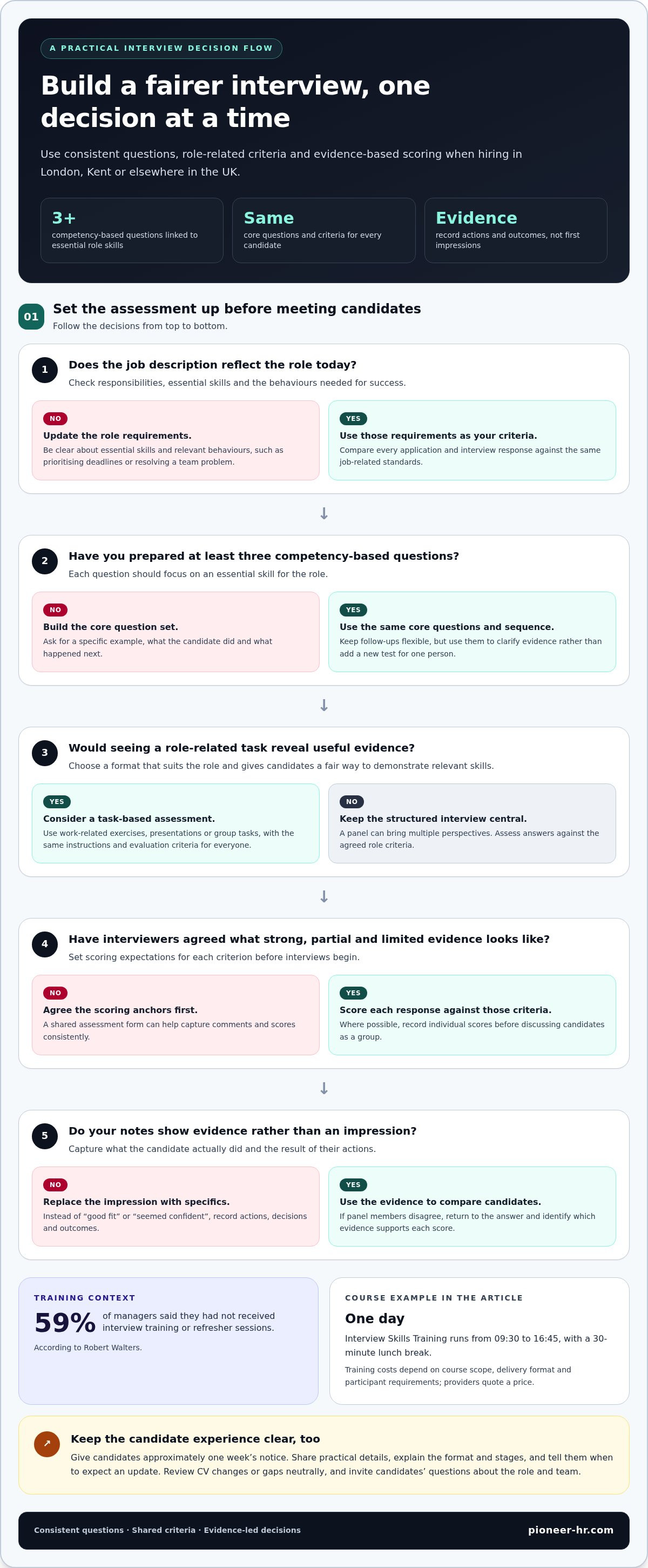
A confident interview isn’t necessarily a fair one. For consistent candidate assessment, include at least three competency-based questions focused on the role’s key skills. Interview training for managers in the UK can also help interviewers choose a suitable format, such as a panel or task-based assessment, and judge answers against shared criteria.
It’s understandable to want flexibility in an interview, especially when candidates bring different experience and perspectives. The goal isn’t to make every conversation sound identical. It’s to give each candidate a fair opportunity to demonstrate relevant skills while keeping the assessment focused on the job.
This guide explains how to develop competency-based questions, score responses consistently and reduce the influence of unconscious bias. It also explores when one-to-one, panel and task-based formats can be useful, whether you’re hiring in London, Kent or elsewhere in the UK. A clear structure helps managers make considered decisions and puts candidates at ease.
Table of Contents
Assessing candidate skills, attributes and behaviours
UK managers can develop their interview skills through training from specialist providers and HR consultancies. Sessions may cover role requirements, interview frameworks, questioning techniques and hiring decisions.
According to Robert Walters, 59% of managers said they had not received interview training or refresher sessions. A structured approach helps interviewers gather relevant evidence, rather than relying on first impressions.
Candidate Skills and Behaviour Assessment
Start by checking that the job description reflects the role’s current responsibilities and required skills. Identify the behaviours needed for success, such as prioritising competing deadlines or resolving a team problem. Ask candidates for a specific example, what they did and what happened next. Follow-up questions can clarify their motivation, values and approach without assuming one career path suits everyone.
Review each CV before the interview, noting employment gaps or career changes that need context. Ask neutrally: “Could you tell me more about this change?” Explore what candidates want from their next position, then compare their answers with the role’s actual demands.
Shortlisting and Candidate Evaluation
Shortlisting is most consistent when managers compare every application against the same role-based criteria. Record evidence of essential skills, relevant experience and behaviours rather than treating a polished CV as proof of performance. For example, a candidate’s project experience may demonstrate planning skills. Before scoring it, ask what they personally contributed.
Make consistent notes after each interview, separating observed evidence from personal impressions. If a candidate explains a difficult decision clearly, record their actions and the outcome, not simply “good fit”. This makes comparisons more useful and helps the hiring team explain its decision.
Preparation shapes candidate experience as well as assessment quality. Give candidates approximately one week’s notice, share practical details, and explain the format and expected stages. A warm welcome and brief small talk can help candidates settle. Inviting questions about the role, team and company makes the meeting feel like a two-way conversation.
Fair treatment continues after the interview. Explain the next steps and when candidates can expect an update, then provide feedback within the timeframe promised. If a candidate asks about team priorities, for example, answer accurately rather than making broad claims. Clear communication supports the employer brand, even when a candidate isn’t selected.
Before making an offer, revisit the candidate’s motivations and questions about the position. Explain the responsibilities, team context and next steps clearly so they can make an informed decision. A timely, specific offer that reflects the conversation is more compelling than a generic message. Consistent assessment helps managers choose suitable candidates while giving everyone a respectful experience.
Structured scoring and reducing unconscious bias
A structured interview gives hiring managers a consistent way to assess candidates against role-related criteria. It also makes decisions easier to explain because evaluators record evidence instead of relying on instinct alone.
Interview training costs depend on the course scope, delivery format and participant requirements; providers give a price after a quote request. Course length also varies: the listed Interview Skills Training course runs for one day, from 09:30 to 16:45, with a 30-minute lunch break.
Structured Interview Design
Plan the interview around the role’s key requirements, then use the same core questions and sequence for each candidate. Begin by explaining who is present, outlining the interview stages and giving the candidate a moment to settle in. A simple opening question about relevant experience can establish context before you move to role-specific assessment.
Keep follow-up questions flexible, but make sure they clarify an answer rather than introducing a new test for one candidate. For example, ask what the candidate personally contributed to a team project. This keeps the structure fair while allowing managers to explore individual evidence.
Consistent Scoring and Bias Reduction
Before interviews begin, agree what strong, partial and limited evidence looks like for each criterion. A job interview assessment form can help managers capture comments and scores consistently. For a project-planning criterion, for example, record the candidate’s actions, decisions and outcomes, rather than writing “seemed confident”.
Score each response against the agreed criteria, ideally before discussing candidates as a group. This reduces the chance that one interviewer’s enthusiasm shapes everyone else’s view. If panel members disagree, return to the evidence and identify which parts of the answer support each score.
Structured testing can assess more than conversation alone. An assessment centre may combine role-related exercises, presentations or group tasks, giving candidates different ways to demonstrate relevant skills. Choose activities that reflect actual responsibilities, and use the same instructions and evaluation criteria for everyone. A task measuring prioritisation, for instance, should be judged on decision quality and reasoning, not presentation polish alone.
Psychometric tests may also be used in recruitment for management roles. Consider them alongside interview evidence, rather than treating a test result as a complete picture of someone’s potential. Managers should understand what each assessment measures and how it relates to the role.
To limit bias, pause before accepting an immediate impression. Ask whether a judgement relates to a stated criterion, and record the supporting evidence. A candidate’s communication style, shared interests or similarity to existing team members shouldn’t substitute for demonstrated ability. Reviewing notes against the same criteria keeps decisions focused on the work.
Keep the process practical for candidates. Explain the format in advance, give clear instructions for any task and leave time for questions. Consistent expectations and transparent scoring help the hiring team assess candidates fairly, whether interviews take place in London, Kent or elsewhere in the UK.
How many competency-based questions should I ask?
For fair, consistent assessment, include at least three competency-based questions focused on the role’s key skills. Effective questions ask candidates for specific evidence from workplace situations.
To assess whether interview training has improved hiring, compare interview records and decisions from before and after training. Review whether managers use agreed criteria, capture relevant evidence and provide a consistent candidate experience.
Competency-Based Questioning
Build each question around a skill the job requires, such as prioritisation, problem-solving or collaboration. Ask candidates to describe a relevant situation, their actions and the outcome. For example: “Tell us about a time you had to meet competing deadlines. How did you decide what to do first?”
Use at least three questions to explore the role’s most important capabilities, rather than asking several versions of the same thing. One interview guide recommends two competency-based questions, so focus on whether your questions cover the role’s essential skills.
Strength-Based Questions
Strength-based questions explore the work candidates enjoy and where they feel most engaged. Ask, “Which part of a recent project gave you the most energy?” Then invite an example of how they used that strength in practice.
One interview guide recommends three or four strength-based questions. Use them to complement competency questions, not replace evidence of capability. For a role requiring client communication, for example, enthusiasm for explaining complex information matters most when supported by a clear workplace example.
Good question design starts with the job description. Identify the capabilities the work requires, then connect each question to one capability. A project-management role might assess planning, stakeholder communication and adapting when priorities change. This gives interviewers a clear reason for each question and helps candidates understand the role.
Keep the main questions consistent across candidates, using follow-ups to clarify individual answers. If one person mentions resolving a team disagreement, ask what they did and what changed afterwards. Probe comparable answers from other candidates in the same way. This lets interviewers explore details without changing the assessment standard.
Evidence-based hiring also depends on what managers record. Note the candidate’s actions and results against the relevant skill, rather than writing impressions such as “confident” or “good fit”. After training, review sample interview notes and scorecards for this distinction. Compare them with hiring decisions and candidate feedback to identify where question design or interviewer practice needs more attention.
Track improvement using a small set of practical indicators: whether interviewers prepare role-linked questions, complete evaluation records and explain decisions using candidate evidence. Review these alongside candidate experience, including whether people receive a clear explanation of the process and next steps. Use the findings to refine questions and support more consistent hiring decisions.
Recognising and reducing interviewer bias
Bias can affect recruitment when interviewers interpret similar evidence differently. Managers can reduce its influence by recognising assumptions and grounding their judgements in evidence related to the role.
UK employers should keep recruitment fair, consistent and aligned with legal obligations, from job advertising through to offers and onboarding. In interviews, use job-related criteria and don’t let assumptions replace evidence of a candidate’s ability.
Training that combines bias awareness, questioning techniques and consistent evaluation can help managers make fairer hiring decisions. Practise with sample answers, then compare how interviewers assess the same evidence.
Conscious and Unconscious Bias
Conscious bias involves a deliberate preference or assumption; unconscious bias can shape an impression without the interviewer noticing. A manager might consciously favour experience from a familiar sector or unconsciously rate a candidate more positively because they share a communication style. In either case, return to the role’s requirements and the evidence provided.
After each answer, ask: “What did the candidate demonstrate?” This helps interviewers distinguish observed skills from assumptions about personality, background or potential.
Bias Awareness for Interviewers
Bias awareness training helps interviewers recognise patterns in their judgements and understand how those patterns can affect recruitment. One useful exercise is to compare two anonymised candidate responses against the same criterion, then discuss differences in scoring. Managers can consider whether a judgement reflects evidence, such as a clear example, or an impression, such as “not a culture fit”.
For every decision, record the evidence and the criterion it supports. This makes it easier to challenge unsupported conclusions during a hiring discussion.
Inclusive Interview Practice
Inclusive interviews make the process clear and give candidates a fair chance to show relevant abilities. Explain the format, welcome questions and consider providing competency-based questions in advance as one possible accommodation for neurodiverse candidates. Keep the assessment focused on the role while allowing candidates to describe their experience in their own words.
Consider how the interview setting may affect participation. For a remote interview, share joining instructions beforehand and speak clearly. For an in-person meeting, explain who will attend and each person’s role.
Build bias reduction into every recruitment stage. Before advertising, agree the essential role criteria. During interviews, use relevant questions; afterwards, review decisions against recorded evidence. These steps help ensure an early impression doesn’t outweigh a candidate’s demonstrated capability.
Interview training is most useful when managers practise applying these principles to realistic situations. Discussing a borderline answer, for example, can reveal whether interviewers assess evidence consistently or rely on different assumptions. Regular reflection helps teams identify where their process needs adjustment.
Interview formats, including panels and task-based assessments
The right interview format depends on what managers need to assess. A conversation may reveal motivation, while a work-related task can show how candidates approach a practical challenge.
A one-to-one interview suits a focused discussion between the hiring manager and candidate. It can help explore a person’s experience and motivations in depth. However, one interviewer brings a single perspective, so clear role criteria and careful notes are important. This format works well when one manager understands the role and can assess its essential requirements.
A panel interview brings colleagues with different expertise into the same discussion. A team leader, for example, can explore day-to-day responsibilities while a technical colleague assesses role-specific knowledge. Agree who will lead each question and how panel members will record evidence. Without a plan, interviewers may repeat questions or leave candidates unsure who to address.
A task-based assessment gives candidates a relevant activity, such as prioritising a sample workload or preparing a short presentation. It can help managers assess practical judgement and communication beyond spoken examples. Set clear instructions and evaluate the work against role-related criteria. Avoid tasks that test unrelated knowledge or require extensive unpaid work.
Assessment centres can combine structured interviews with exercises or tests. Recruitment processes for management roles may also use psychometric tests. These formats can reveal different aspects of a candidate’s approach, but every activity should have a clear purpose. A group exercise, for example, may help assess collaboration, while an individual task may show how someone organises information.
Candidate experience depends partly on knowing what to expect. Tell candidates in advance if the interview includes a panel, presentation or task, and explain how each stage will run. For a virtual interview, provide joining details and explain whether candidates need to share a screen. For an in-person meeting in London or Kent, clarify who they’ll meet and where to go.
Choose a format based on the role’s demands, not the employer’s usual practice. If the job involves frequent stakeholder discussions, a structured conversation may provide useful evidence. If it requires analysing competing priorities, a realistic exercise may add insight. Different formats can help candidates demonstrate relevant strengths in different ways, provided expectations are clear and assessment remains role-related.
Before confirming the format, ask what each stage will reveal that the others won’t. A panel and a task can complement each other, but using both without a distinct purpose can make recruitment unnecessarily complex. A considered choice helps managers assess candidates effectively while keeping the process clear and proportionate.
Pioneer HR: Retained HR Support
Pioneer HR provides Retained HR Services for UK employers who need ongoing practical HR guidance. If your organisation wants to make recruitment more consistent, this support can help you consider how hiring fits into wider people practices and management responsibilities.
This support may be useful when interview standards vary between teams, managers need clearer HR guidance, or recruitment decisions connect to broader workforce planning. Salary Benchmarking, Reward and Benefits Review or Fractional Chief People Officer support may also help with wider people decisions, depending on your priorities.
For a conversation about Retained HR Support and your organisation’s needs, visit pioneer-hr.com.
Make fair interviewing part of everyday management
Fair hiring becomes more dependable when interview practice is treated as an ongoing management capability, not a one-off task. Managers can reflect on their decisions, share learning with colleagues and refine their approach as roles and teams change. This ongoing attention makes candidate assessment a considered part of how your organisation works.
Thoughtful interview training for managers in the UK can support this wider development by helping managers apply people skills consistently. If your organisation is reviewing how managers lead conversations and make people-related decisions, Pioneer HR’s Management Training can support that work.
For a conversation about your organisation’s training priorities, contact Pioneer HR to discuss management training. A practical next step can help your managers build a more confident, fair approach to hiring.
Frequently Asked Questions
Should I ask every candidate the same questions?
Ask every candidate the same core questions so you can compare relevant evidence fairly. Follow-up questions can still clarify individual answers. If one candidate describes leading a project, for example, ask about their personal contribution and the outcome. Use comparable follow-ups for other candidates’ examples, so further questions add context rather than changing the standard.
What’s a simple way to reduce bias in interviews?
Record the role-related evidence behind each judgement before discussing candidates with colleagues. Instead of writing “strong presence”, for example, note the specific explanation or decision that demonstrated a required skill. Compare those notes with the agreed criteria. This pause helps interviewers distinguish observed capability from familiarity, shared interests or assumptions about someone’s background.
What’s in the interview guide?
A practical interview guide can set out the role criteria, questions, follow-up prompts and a consistent way to record evidence. It can also explain how to open and close the discussion, manage time and reach a decision. Interview training may cover legal frameworks, matching the job and person, interview structure, questioning techniques and decision-making. Concise course notes can help managers apply what they learn at work.
Where is this course delivered?
Interview skills training can take place at an employer’s offices or as a live virtual course using Zoom or Teams. An off-site venue is another option if workplace facilities aren’t suitable. The right format may depend on where managers are based, the facilities available and whether the group would benefit more from in-person practice or virtual participation.
Who is this course suitable for?
Interview skills training is relevant to line managers and other employees involved in hiring decisions. It can help first-time interviewers, managers who interview occasionally, or panel members seeking a clearer role in candidate assessment. Teams recruiting across departments may also benefit from a shared approach to questions, evidence and decision-making.
What does interview training for managers in the UK cover?
Interview training for managers in the UK can cover interview preparation, role requirements, question selection and answer evaluation. It can also help managers plan a clear structure and make decisions based on job-related evidence. A manager hiring for a supervisory role, for example, might practise exploring how candidates handle team priorities, then assess each answer against the position’s actual demands.
Are there online and in-person interview training courses for UK managers?
Training can take place in person at an employer’s premises or live online through platforms such as Zoom or Teams. Some courses can also be held off-site if workplace facilities aren’t suitable. For managers based across the UK, a virtual session may simplify participation; in-person training can support live group discussion and practice. Choose the format that suits the participants and learning activities.
How can managers structure interviews and use competency-based questions?
Start by selecting questions that assess distinct skills required for the role, then arrange them in a logical sequence. For each competency, ask candidates for a specific example and use follow-ups to clarify their contribution, reasoning and outcome. Keep core questions consistent across interviews, allow time for candidate questions and make sure the final evaluation relates to the position rather than general impressions.



Comments